Showing posts with label Old Station Teahouse. Show all posts

Friday, 24 April 2015

TOD Tour, Day 73 - Cape Hillsborough to Airlie Beach

Another early rise this morning to watch the kangaroos on the beach.

The event was ransacked by the over-eager photographers. Despite all appearing to have powerful digital SLR’s with long zoom lenses, they felt it necessary to be within touching distance. As a result, the seven or eight kangaroos who were present reacted to the tight circle of snappers, most of them with inbuilt and some with post flash units attached and popping regularly and left soon after the first sign of the sun. Meanwhile, some elderly folk and others who were just respectful of these wild animals, had their view blocked and any photos they might have liked to take full of human animals.

One of the invaders was even dressed in a yellow high-vis shirt! What small chance there was, that we wouldn’t already know he was a nong, was at least removed.

The irony came when the majority of the kangaroos hopped away and one, passing in the distance, transected the sun and my position and I scored the money shot anyway!

What did John Lennon say about instant karma?

We left the caravan park at about 9:00am and stopped again at the Old School Teahouse: this time for a few hours of tea and snacks and some blog and Facebook time.

A few other stops were planned but as I had laundry chores to do, we pressed on to Airlie Beach, where we will see out Anzac Day and tick a rather long vacant box on the bucket list, a cruise to the Great Barrier Reef and some snorkelling Nemo Inc.

Our digs are fantastic. We don’t usually like resort parks but the price was right and the staff really friendly. Our site is shielded on the north side by palms which means we didn’t need to erect the canopy for shade and with sunshine all the go for the next three days, we’ll have no need for coverage from rain.

Thanks to Sam – my avid researcher – while Sue shopped, I went on the hunt for a shock resistant, waterproof camera and managed to score a very good deal. For those in the camera know, the age old debate between Canon and Nikon has always been a spirited one. I shoot with two Canon cameras but the comparisons in the waterproof models leave the Nikon as the superior machine. In fact, Canon comes in a distant fourth behind a Ricoh (no 1 but too expensive), the Nikon and then a Panasonic. As a result, we now have a Nikon AW-120 in the stable for those times when the going gets rough and tumble.

I also bought a new beach hat as the old one disappeared about a week ago.

After shopping, we took a spin along the main drag in Airlie – bars, cafes, shops for cooler people than me and tourist dives. Lots of good looking sorts with perfect tans and blonde hair and that was just the blokes.

An early night tonight, as we’ll be attending the local Dawn Service and then returning home to watch the ABC coverage from Gallipoli, Villers Bretonneau and then Lone Pine, where we might even catch a glimpse of my great uncle’s name on the wall behind the speeches.

Great Uncle Albert Langston was killed on or about the 8th August, 1915, in the Battle for Lone Pine. He was listed as missing in action, presumed killed for eighteen months until a field court in Northern France identified a fellow soldiers who recollected seeing him fall. This fellow said in his evidence, “Albert was a good bloke.” Always fills me up when I read it. His grave is unknown. A few years ago, his great grandson, my boy Sam, found his name on the roll of the dead at Lone Pine.

Another great uncle, Jim Smith, my Mum’s uncle, lost a trigger finger at Gallipoli and was repatriated home to Australia.

It was Albert’s death that drove his brother, my grandfather Arthur, to join the AIF. He was shot and badly wounded at Villers Bretonneau, three weeks before the fourth ANZAC Day in 1918. Machine guns opened him up from his left hip to his right nipple but he survived 8 hours on that farmers field just south of the town, was retrieved in a cease fire, whip-stitched and eventually sent to England for surgery and somehow survived to return home with ghosts chasing him for the next twenty odd years.

My Dad had always wanted to return to that field in order to understand his dad. To pay homage to him, I guess, but he never did. In 2012, I had the chance to do so for him and I stood there, a committed pacifist, conflicted by family pride and the horror of what had happened there. It gave rise to “Poppy’s Paddock”, a poem from my last collection and I’ll include it here as my homage to him, to my dad and to all those incredibly brave men and women who fought, survived and somehow returned to “real” life afterwards, haunted by vapours and hard memories and the agonised calls of mates who didn’t come home.


Poppy’s Paddock
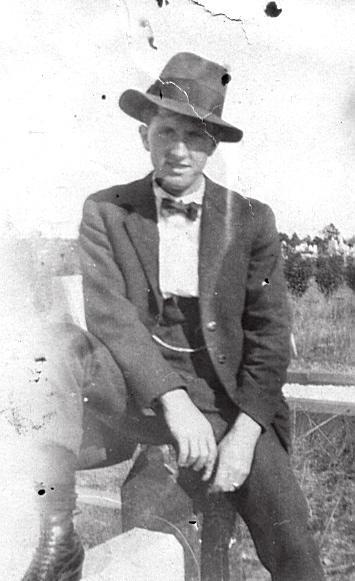
Arthur George Langston - my Pop

Standing among the sugar beet
as soft rain confuses autumn sunshine
I can hear them screaming
in this French farmer’s field
on the rolling Santerre plain.
Maschinengewehr rattle away,
cranking death or worse,
bullets traced on a starless canvas
finding flesh and bone to rent.
Slow turns take it all in:
maps and diaries and body tallies
no longer point and click accounts
or pages turned for reference.
I can smell the earth.
It sticks to my boot tread,
wedges beneath finger nails,
pancakes on my knee
as I crouch to touch it,
to make the connection
between this place
and home.

He’s lying out there in the dark
in a land for no man
full of fallen men,
this dying half kilometre of red dirt
to Monument Farm.
He is only stories to me,
told by my mother,
of my father’s father
and an old scanned photograph,
larrikin grin,
baggy suit,
fedora pushed back,
eyes sparkling trouble, even in sepia.

A farmer waves recognition,
one grandson to another,
steering his harvester through sugar beet,
working soil bought with obscene riches.
Standing in the fresh tilled field,
I’m close enough
to cross the gap of time,
to gather the experience
in small parcels,
standing in the crossfire.
Long terrible minutes of tears
tear their own damage
as I cry in loud sounds
and confusion.

I see him finally,
opened from one hip
to the other nipple,
lying for six hours in the mud,
refusing to die,
his mates changed by the experience
into corpses
or walking carcases,
the emotion hollowed from them,
replaced by steel
tempering their survival,
only to rust at home.
No telegrams for their families,
just a slow vacancy
of lunacy and grog.

I’m trapped in a conflict,
pacifist disgust confirmed,

family pride overflowing.
Nothing to offer
but tears I can’t stop.
I found the grandfather I never knew,
lay his medals among the sods
to be soaked in his reality,
bridged a connection to his son,
walked on the bones of conundrum.

The field of screaming ghosts remains,
just south of Villers-Bretonneau.
Southern Sons calling from the tilled rise
across the Hangard Road,
their voices low and tired,
groaning since that 4th Anzac.
I placated them with tales of Pop,
news from four generations
after their rough run
to Monument Farm.
I cried with their remnant memories,
scattered among sugar beets,
shook with disbelief
we could be so cold and cruel
over a point of view.

I offered gratitude inadequate,
spoke the Lords Prayer,
left them there,
another callous re-enactment.
My face washed clean
I’ll keep the deeper stains
as ammunition against hawks
with swooping points of view.

TOD Tour, Day 72 - Sunrise, Sunset, Kangaroos & Cups of Tea

Sunrise at Cape Hillsborough
Pound for pound, today was the best day of The One Day Tour, thus far. No doubt, others will compete with it and in the end, it will be impossible to tell one glorious, highlight-riddled day from another. Enough that this will be one of them.

Let me try and explain why.

For starters, I slept well.

For some reason, bladders don't work normally on the road or rather, they work to a new normal. What is one visit to the toilet at home, if any, during the hours of sleep, becomes several when the toilet is now up to a hundred metres away. Don't ask me why unless you are developing a thesis.

Last night, I was on a home footing and even better, so was Sue.

As a result, I woke bright-eyed just before sunrise, with deep purple and crimson messages written on the first ten degrees above the ocean horizon. We bounced from bed - me dressed, Sue still resplendent in Friesian flannelette - and took ourselves to the beach, eager to be alone with one of the rare treats of an Australian sunrise and one almost unique to the beach at Cape Hillsborough. In the hour before sunrise every morning, kangaroos gather on the beach to rake the wet sand for mangrove seed pods to supplement a diet left short of key nutrients they would normally find in the bush. How they discovered buried in the sand in the first place is one of those adaptive mysteries of evolution.

As we emerged from the short track to the beach, there they were, about six of them in a group ... as were about fifteen humans, variously arranged on chairs with binoculars, cameras and hot coffee. It's the reason why some people come here, because at sunrise, when the new sun eases it's way through the early stages of the white light spectrum, the coats of these macropods glow a rich browny red in the first rays. Taken in that light, in this unusual and normally unexpected context, it's an event not to be overlooked.

Of course, before we arrived at that point, there were range of colours to be sumptuously enjoyed above the horizon and glows spreading from the tree tops and down the cliffs as the sun climbed out of bed.

It was an hour of silent appreciation.

As we turned to leave the beach, later than most, an English voice called out, "Peter ... Peter ... it's Ross."

It was Ross and his partner Chrissy, whom we met at Mt Morgan and were subsequently mentioned in these dispatches. Small worlds shrink further on the road and it has been our luck, over many trips and incumbent years, to be blessed with repeat meeting to be with those we would have chosen to catch up with again.

To recap, Ross and Chrissy are from Oxford (the place not the institution) in the Old Dart and are in Oz on a working visa but are currently doing some road miles to add to their already impressive back catalogue of Australian experiences.

After a quick exchange of what's what, we agreed to meet up for drinks this evening. This day was unfolding nicely and we still hadn't had breakfast.

After gobbling cereals and yoghurt, we donned the walking boots and set of on the Andrews Point walk, only typically for us, in the reverse direction. This was to take advantage of the low tide, as the traditional end of the track is across rocks and beach that submerge as the tide returns. We struck out for Wedge Island, by the shortest possible route across the sand, covered in Sandballer crabs, to reduce the percentage of rock walking we would have to do. All went well until the sand turned to softer sand, which morphed to even softer sand and then to grey mud. Keen for company, it buried each successive step further into itself, until my ankles were only just visible among the spiral trails of the Acorn worms. It might have been an easy retreat but it wasn't, as the first turn and step to firmer ground was a philosophical one only. If only my boots had shared my feet's desire to depart. They stayed and so did my lower half, while my top half's momentum carried my weight forward and very nearly resulted in an inglorious, face first plop into the grey goop. Luckily Sue's arm shot out in support.

Applied strength eventually released me but it was a sloppy slow trip back to the rocks, the first ten or so metres of which were covered with razor sharp oyster shells.

Wedge Island
Following our escape, we made our way across the rock causeway that links to Wedge Island while the tide is away on Moon assisted duties. The views back to the beach were pretty but not quite worth the effort made to enjoy them. We returned the way we had come - extant the mud - and started climbing the stone steps which marked the end of Andrews Point walk ... remember, we were doing it backwards. It was a sharpish climb, with pockets of rainforest along the way and a series of small lookouts, each with its own special view. In the places of filtered light, beautiful butterflies with variegated blue wings rose in clusters every few meters. Trying to capture them in photographs or video was a bit like holding onto lightning but the experience would have been enough. There was something quiet serene about their erratic, silent flight, especially in the masses they gathered and moved in.

Each successive lookout gave us a new set of gasps until we reached Turtle Lookout. Here, at the highest point of the walk, our view extended, literally, from east to west, a full 180 degree field of vision which faced south to Mackay. Blue sky, blue green water.

Below us, way below us, four sea turtles dived and surfaced in their own time, oblivious to our presence, gobsmacked above. A dolphin was conducting rolling parabolic dives off the point and a Brahminy Kite floated past us several times. There were butterflies here too: the blue ones who had buzzed us all the way up the track, orange ones who darted about low to the stunted vegetation and just a few white ones.

The crowning glory was a huge sea eagle, which we first spotted far off to the east and watched in awe as it floated closer and closer, until it passed immediately overhead, perhaps only twenty meters above us. It was a breathtaking communion.

Certain that we had seen the best the walk could offer, we were again stunned just five minutes past Turtle Lookout, as the vegetation disappeared on our right hand side and opened up a vista across the small bay to Cape Hillsborough. It was a view which remained constant for the next two hunted metres before we again descended.

We could have stopped the day right there and not have been short changed but decided instead to find the Old Station Teahouse, back along the road which bought us here. The business gets its name from its building, which was originally the railway station at Marion, in the Pioneer Valley west of Mackay. The owners, Michelle and Dwayne, bought the building through tender and transported to its current spot, which they had previously traded as a nursery. The Teahouse now provide a variety of well prepared, tasty dishes for lunch and a great cuppa (my personal favourite being French Earl Grey). Michelle was good enough to listen to my dietary restrictions and design a meal specifically for me, ex menu: a really delicious, healthy ham salad.. Access to wifi allowed me to catch up on absent blogs and photos and then they joined us for a long chat about the area, places we might visit and Dwayne's plans to take the family on the roads of Australia. It was a three and a half hour complete and delightful surprise.
The Old Station Teahouse

By the time we returned and read for a time, it was back down to the beach and another incredible sunset of pinks and orange. If only we hadn't needed to make plans for the Anzac Day weekend, we would have stayed here for longer.


We will definitely return!